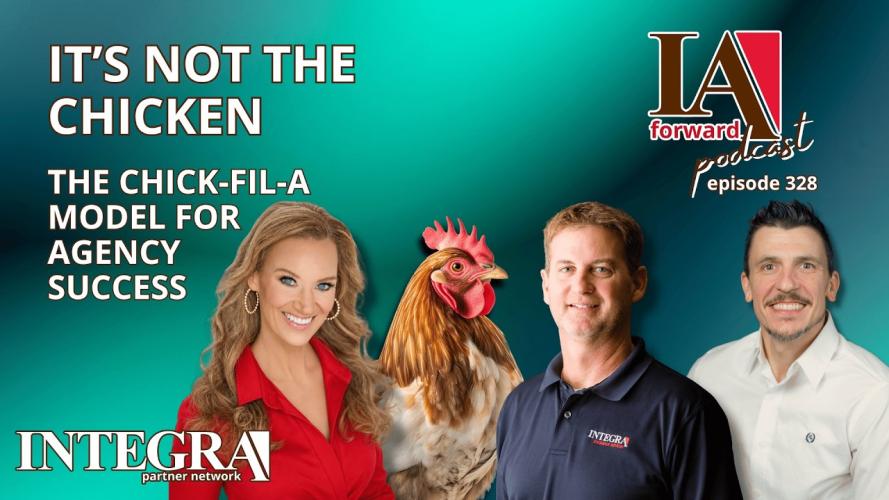
A Chick-fil-A owner-operator may not spend every day standing behind the register.
But when the lunch rush begins backing up, that owner can step in.
That image became one of the clearest leadership lessons in this week’s IA Forward conversation.
The episode was not really about chicken or drive-through efficiency.
It was about what happens when a business grows and the owner slowly becomes disconnected from the work, employees, customers, and culture that made the growth possible.
For an insurance agency owner, the question is simple:
As your agency grows, could you still step back into the operation if you needed to?
You Do Not Have to Do Everything
Owner-operator leadership does not mean the agency owner must quote every policy, answer every service call, or approve every decision.
That would prevent the team from developing and eventually turn the owner into the agency’s largest bottleneck.
The goal is not to continue doing every task personally.
The goal is to remain close enough to the business that you understand how the work is being done.
During the podcast, Shane explained that he no longer quotes and sells insurance every day. His responsibilities have changed as the organization has grown.
But he still works inside the agency’s systems. He sees how the business operates and understands the process well enough that he could step back in and work through a quote or present a proposal if necessary.
That is different from an owner who disappears for weeks and no longer knows what is happening inside the agency.
Delegation creates capacity.
Disconnection creates risk.
Your Business Can Feel Your Absence
Employees notice what the owner pays attention to.
They notice whether leadership understands their workload.
They notice whether problems are addressed quickly and whether the standards discussed in meetings are reflected in daily behavior.
Clients notice too.
They may not expect to speak directly with the owner every time they contact the agency. But they can often feel the difference between an organization with engaged leadership and one that has become distant, generic, or overly corporate.
The podcast compared this with a banking experience that changed after multiple mergers.
The local relationship disappeared.
Reaching someone became more difficult.
The experience began to feel like a numbers game instead of a relationship.
That is one of the risks when ownership begins thinking only like an investor.
The agency may keep the same name and office, but the culture can still feel the owner’s absence.
Presence Does Not Require Sitting Behind a Desk
Being present does not mean remaining inside the office every minute of the workday.
The episode also discussed an agency owner who spends significant time in the community—meeting people, attending local events, supporting organizations, and serving as the face of his agency.
His team handles much of the daily activity inside the office. That allows him to spend time building relationships outside it.
That is still owner-operator leadership.
He remains connected to the agency’s reputation, customers, and community. He has developed a capable team, but he also understands the business well enough that he could step back into production if needed.
Leadership can happen behind a desk.
It can also happen at a community event, during a difficult client conversation, or in the agency kitchen when the coffee needs to be refilled.
The location matters less than the example.
Small Actions Reveal the Real Culture
Agency owners often communicate culture through mission statements, core values, websites, and employee meetings.
Their behavior communicates it more clearly.
When an owner notices a problem and helps solve it, the team sees that no task is beneath leadership.
When an owner listens before making a major change, employees see that their experience matters.
When an owner understands the agency’s systems, customers, and workflows, the team knows that leadership decisions are connected to the reality of the business.
When the owner is willing to refill the coffee, take out the trash, help during a busy period, or speak directly with a frustrated client, servant leadership stops being a slogan.
It becomes visible.
That is why the Chick-fil-A comparison works.
The franchise owner is expected to lead the business, not merely invest in it.
The owner’s presence helps protect the culture and makes a consistent customer experience more likely.
The Difference Between Delegating and Disappearing
A strong agency owner should delegate.
Employees need room to make decisions, solve problems, and develop into leaders.
But delegation should not become an excuse to stop paying attention.
An owner can give employees authority while remaining involved in the culture.
An owner can stop handling every account while remaining connected to the customer experience.
An owner can spend more time leading the organization without forgetting how the organization operates.
The goal is not to remain responsible for every task.
The goal is to avoid becoming a stranger inside your own business.
The Succession Question
The owner-operator mindset becomes especially important when an owner begins moving toward retirement.
An owner can retain ownership without remaining responsible for the daily operation.
But someone still needs to carry the culture forward.
That person may be a family member, president, chief executive, or another agency leader who understands what made the business successful and is committed to protecting the customer experience.
Retirement is not the problem.
An agency operating without an active leader is the problem.
Someone needs to remain close enough to hear what employees are saying, see what customers are experiencing, and recognize when the agency is drifting away from its standards.
What Would a Customer See?
Imagine one of your customers spending a full day inside your agency.
What would they learn about your leadership?
Would they see employees who are trusted to make decisions?
Would they see a team that genuinely cares about the people it serves?
Would they see an owner who understands the business?
Or would they see a culture that has learned to operate around an owner who is rarely present?
Growth should give an agency owner a different role.
It should not make the owner a stranger.
At the end of the episode, Tonya shared a quote from John Wooden:
“The most powerful leadership tool you have is your own personal example.”
Your employees do not need you to do everything.
They need to see that you understand the work, care about the people, and are still willing to step behind the counter when the situation requires it.
Most Recent
Your Best Employee Might Be Drowning Quietly
High performers usually do not stop being good employees overnight. Sometimes they simply run out of room.One of the easiest...

Are You Doing $500-an-Hour Work or $25-an-Hour Work?
Agency owners have a unique problem.You can do almost everything.You can chase electronic signatures.Update the calendar.Process paperwork.Handle bookkeeping.Follow up on...

Don’t Let a $3,000 Incentive Cost You $50,000
Carrier incentives can be great. The problem starts when short-term money changes a long-term strategy.It is incentive season.After several difficult...
Your Best Niche Might Already Be in Front of You
Agency owners hear a lot about finding a niche.Pick an industry. Become the expert. Build your marketing around it.That can...