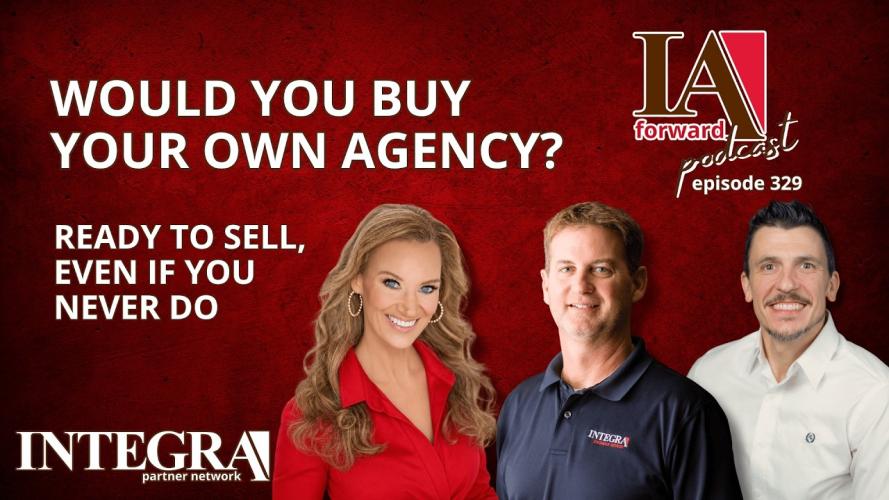
There is a surprisingly simple first step to increasing the value of an insurance agency:
Have financial statements.
That sounds obvious.
According to the conversation in this week’s IA Forward episode, it often is not.
Many agency owners are excellent producers.
They know how to sell.
They know how to build relationships.
They understand insurance.
But becoming an agency owner requires an entirely different set of skills—and financial management is one of them.
Too often, the financial strategy becomes:
Check the bank account.
Make sure there is enough money.
Pay the bills.
Keep moving.
That may tell you whether you can make payroll this week.
It does not tell you whether you are building a healthy business.
Your Bank Balance Is Not a Profit-and-Loss Statement
A checking-account balance gives you one number.
It does not explain where the money came from.
It does not show where it went.
It does not tell you whether expenses are rising faster than revenue.
It does not show whether the agency is becoming more profitable.
It does not tell a potential buyer what the business actually earns.
A basic financial foundation should include, at minimum, a profit-and-loss statement and a balance sheet.
A cash-flow statement can provide even more insight.
These reports turn the agency from something you simply operate into something you can actually measure.
And once you can measure it, you can make better decisions.
Separate the Business From Your Personal Life
The episode also touched on another common problem:
Mixing personal and business finances.
One credit card should not be paying for both agency expenses and Saturday breakfast.
When those expenses are mixed together, understanding the actual performance of the agency becomes much harder.
It also creates a mess when someone eventually needs to evaluate the business.
A potential buyer should not have to determine which expenses belong to the agency and which belonged to the owner personally.
Neither should your accountant.
Clean books create credibility.
Messy books create questions.
And when someone is evaluating whether to invest significant money into an agency, unanswered questions reduce confidence.
You Do Not Have to Become an Accountant
The answer is not necessarily spending Saturday nights learning accounting.
Some agency owners enjoy financial work.
Others would rather do almost anything else.
That is okay.
One of the strongest recommendations from the episode was to bring in someone who understands it.
That may be a CPA.
It may be a bookkeeper.
It may be a fractional CFO or accounting service familiar with insurance agencies.
The title matters less than the result:
Someone competent is making sure your financial information is accurate, organized, and useful.
There is also another benefit.
Every hour an agency owner spends struggling through a task they are not good at is an hour they are not spending on something only they can do.
Selling.
Building relationships.
Leading employees.
Meeting clients.
Developing the agency.
Sometimes spending money on the right professional does not simply remove an expense from your time.
It gives that time back to the parts of the agency that generate growth.
Clean Financials Make Your Business Easier to Trust
Imagine two agency owners approaching a potential buyer.
The first hands over organized financial statements, clean books, carrier reports, and several years of consistent information.
The second says:
“I can probably get you my tax return.”
Which business feels safer?
That matters because one of the biggest concerns in any acquisition is whether the buyer can trust the information they are receiving.
Clean financials help answer that question before it is ever asked.
They make the agency easier to understand.
They make performance easier to evaluate.
And they create confidence that the rest of the business may be managed with the same level of professionalism.
The Best Part Is You Do Not Have to Sell
Here is the important part:
None of this requires you to actually sell your agency.
That was one of the strongest points in the episode.
The things that make an agency easier to sell are often the exact same things that make an agency better to own.
Clear financials.
Better systems.
Documented processes.
Accurate customer information.
Less dependence on the owner.
Better visibility into profitability.
Less chaos.
Less stress.
The goal is not to constantly prepare for your exit.
The goal is to build something valuable enough that you have options.
Maybe your children take over.
Maybe an employee eventually buys it.
Maybe another agency approaches you with an offer you cannot ignore.
Or maybe you never sell at all.
Either way, you still get the benefit of operating a better business.
Run a Business You Can Actually See
You cannot improve what you cannot understand.
And you cannot fully understand your agency through a checking-account balance.
Build the financial foundation.
Separate the business from your personal expenses.
Bring in professional help where you need it.
Know what the agency earns.
Know what it costs to operate.
Know where the money goes.
You do not need a finance degree.
You need enough clarity to make decisions based on information instead of instinct.
Because whether you sell your agency in five years, 25 years, or never at all, a business with clean financials is a better business to own.
Most Recent

Integra Insurance Services Named a 2026 Pinnacle Award Winner
Applied Systems recognizes Integra for innovation, technology, and the way we continue to move our organization forward.We are proud to...

A Soft Market Can Expose a Weak Client Relationship
When consumers suddenly have more options, price is no longer enough to keep the book together.For the last few years,...

Are You Building Customers or Clients?
There is a big difference between winning a policy and becoming someone’s trusted insurance advisor.A customer can buy something from...

Stop Competing With Billion-Dollar Insurance Ads
If your entire sales process starts with “let me get you a quote,” you are playing a game the biggest...